
Welcome
The Meddybemps Lake Assocation was first formed in 1961. In the 1980's with the threats of acid rain, high mercury levels found in fish, the beginning of invasive plant issues in southern Maine lakes and threats of pollution to many lakes, we made our focus lake preservation. Note: Name changed in August 2023 from LMA

Water Testing
Overview
Phosphorus - Where Does It Come From?
Phosphorus - Where Does It Come From?

Water testing is a major focus of this organization. As citizen scientists we are very interested in how our lake measures up to the scientific definition of a healthy body of water.
A comprehensive testing program began in 1995 in which multiple sites throughout the lake were chosen to take samples from. Some of 23 indicators tested are:
Chlorophyll a
Dissolved Oxygen
Aluminum
Magnesium
Sodium
Nitrate
Sulfate Ion
Ammonium
Total Suspended Solids
and more
This level of comprehensive testing is done every 5 years. We now have 6 test sets to compare and track the health of the lake through the water test results. This year, 2025, will mark our 7th testing period. These comprehensive tests are expensive and cost thousands of dollars each time. Dues, donations to the Water Fund, and fundraising supports this work.
In addition, our water testing team does annual testing which consists of:
Secchi Disc readings
Total Phosphorus
Dissolved Oxygen
Phosphorus - Where Does It Come From?
Phosphorus - Where Does It Come From?
Phosphorus - Where Does It Come From?
Phosphorus can come from many sources, such as fertilizers applied to agricultural fields and lawns; deposition of nitrogen from the atmosphere; erosion of soil containing nutrients; and sewage discharges from faulty septic systems and pets.
Currently the lake is in a balanced equilibrium state where Phosphorus remains tied up in lake
sediments. But residents should remain vigilant in protecting the shoreline from any type of erosion that could change the delicate balance that exists between runoff and the potential impacts on the lake chemistry and the eutrophication
process. See our Section on Property Owner Education to see what you can do to help keep our lake balanced.
Eutrophication- What You Need To Know
Eutrophication- What You Need To Know
Eutrophication- What You Need To Know
Phosphorus is a major limiting nutrient in lakes. Excess phosphorus can lead to a process called eutrophication. Eutrophication is a process whereby water bodies, such as lakes, estuaries, or slow-moving streams receive excess nutrients that stimulate excessive plant
growth (algae, periphyton attached algae, and nuisance plants and weeds). This enhanced plant growth, often called an algal bloom, reduces dissolved oxygen in the water when dead plant material decomposes and can cause other organisms to die. Water with a low concentration of dissolved oxygen is called hypoxic.
Eutrophied body of water
Eutrophication- What You Need To Know
Eutrophication- What You Need To Know
Invasive Plants
Overview
The introduction of non-native invasive aquatic plant species into Maine has been escalating with widespread destructive consequences. Our goal is to prevent these plants from reaching our lake. These plants are moved about in complex and often unseen ways, and the speed at which a new introduction can explode into an ecologically and economically disastrous infestation is well documented.
Courtesy Boat Inspection

CBI is a program of the Maine Department of Environmental Protection. MLA applied for grant funding for this program first in 2013 and has continued it each year since.
You can check too
What Courtesy Boat Inspectors do:
These are all the areas that boat owners should check when removing your craft from any body of fresh water.
What Courtesy Boat Inspectors do:
What Courtesy Boat Inspectors do:
- Discuss how invasive plants are spread
- Show boaters how to inspect
- Urge boaters to inspect before and after every launch
- Distribute info on invasive plants
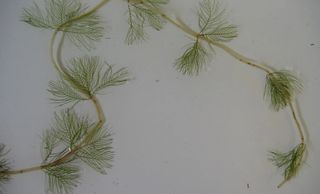
What do invasive plants look like?
There are 2 types of milfoil that are prevalent in infected Maine lakes:
Variable Water-Milfoil (above)
and
Eurasian Water-Milfoil (right)
You must be trained to identify these plants as they are often confused with native species. LMA offers workshops through the Maine Volunteer Lake Monitoring Program bi-annually.
Get more information
https://www.maine.gov/dep/water/invasives/inspect.html
www.mainevlmp.org/mciap/herbarium/EurasianWatermilfoil.pdf
www.mainevlmp.org/mciap/herbarium/VariableWatermilfoil.pdf
Sign up to be a CBI inspector : email
Durell Buzzini at meddybliss@gmail.com or use the Google Sheets scheduler:
The sign-up for shifts is done on Google Sheets:
MLA CBI 2025 Sign Up Calendar.xlsx - Google Sheets
Lake Level Monitoring
The Dam
Working with State Agencies
Working with State Agencies
There is a dam on the lake that sits at the opening of the stream that connects to the Dennys River. The level of the lake is determined by the amount of water allowed to go through the dam, the evaporation factor from hot weather and the amount of precipitation combined.
The dam is regulated according to 1st what the Department of Marine Fisheries need for the work they do preserving fish species in the Dennys River and 2nd with the needs of the Lake's recreational users.
Working with State Agencies
Working with State Agencies
Working with State Agencies
The Dam and fish ladder are operated and maintained by the Department of Marine Resources out of Jonesboro. The small "Canal" dam adjacent to the State boat ramp and a part of that property, is a fixed height. It has a small fish ladder that allows Alewife passage into the lake in the Spring, but in dry years the Canal may be dry by late August or September.
The main dam is a large wooden structure which is quite old. In recent years it has had issues with water leaking through the dam structure (as pictured above) and there have been repairs to mitigate, but not eliminate that. In addition a huge fish ladder is in place at the dam that allows huge amounts of water to escape the lake. All of these factors are taken into account in determining the dam's setting.
The Canal and Alewives
Working with State Agencies
The Canal and Alewives
The canal has a small fixed height "dam" over which water flows out of the lake and eventually reaches the Dennys River. Likewise some species swim up the canal to get into the lake. Alewives, an anadromous or sea-run fish are the most common. They are important to the lake for several reasons. They provide food for the smallmouth bass for which this lake is famous. They also provide food as bait for lobstermen.
Optimal Lake Level
Optimal Lake Level
The Canal and Alewives
What is the optimal level for Meddybemps Lake? If you ask 10 people you will likely get 10 different answers. For some it is high enough to get in and out of their docks without hitting bottom, for some it is to keep it steady during loon nesting season, for others it is keeping it low enough that their island doesn't have ponds on it and the docks are accessible. Suffice it to say, it can be a hot topic!
The bottom line is that the Association doesn't have a lot of say in how the dam is managed. Being over an hour ride from the Dam, the Marine Resource staff cannot come by that often either. So we have members who report water levels to them and we are in the process of installing a remote camera so that they and our members will be able to see what is happening at the dam.
Optimal Lake Level
A NEW DAM
Starting this summer the current dam is being torn down and replaced by a natural passage of water that will blend with the natural shoreline, maintained by nature and not humans.
The goal is to have the lake fluctuate with natural conditions (i.e. seasonal water table, rainfall, snowmelt, etc.) eliminating the extreme drops we have seen in the past. It should experience a normal high level in the spring and a normal low level in the late summer/fall, just like other naturally regulated lakesand ponds in the Northeast. This normal fluctuation should be typically less than 2 feet, however in an extreme drought year, it is conceivable that it will be a bit more. The good news is it will be much less than we've experienced with the current dam.
Annual Cleanup Days

A Community Project to be done annually throughout the month of July
Each year Association members and friends scour the area identified for debris. They collect it and dispose of it to keep our lake and its confines as pristine as possible.
2026 - Individual Cleanup being done by landowners on and near their property and post your trash pi
Fundraising
Annual Blueberry Pancake Breakfast
Annual Blueberry Pancake Breakfast
Annual Blueberry Pancake Breakfast
Each year on the Saturday before the Annual Meeting, we host a Blueberry Pancake Breakfast featuring delicious pancakes, real maple syrup, sausage and bacon, muffins, fruit salad and egg casseroles.
August 1st, 2026, 8-10 AM
Silent Auction
Annual Blueberry Pancake Breakfast
Annual Blueberry Pancake Breakfast
A silent auction is set up at the breakfast and usually has over 50 items to bid on.
Breakfast and Auction will be on August 1st, 2026
Featured memorabilia for sale
Annual Blueberry Pancake Breakfast
Featured memorabilia for sale
Each season our Fundraising Committee makes useful items with Meddybemps Lake on them available for purchase.
Check our Facebook page for up to date information
Dues
Featured memorabilia for sale
Each member pays dues of $15/year. Click here to pay your dues online at:
Special Funds
There are 2 special funds that supporters make donations to in honor of former members of the Association:
- Bob Holloway Fund that built the kiosk at the Town Dock
- Ed Ketchen Water Fund to raise money that supports water testing. [See below]
Scan to pay dues

The Association will stay adequately funded to accomplish the multiple initiatives undertaken with your support of our various fundraising activities.
Ed Ketchen, Director Emeritus

Oh, hand me down my trekking pole; Down Moosewood Lane I’ll take a stroll. To Meddybemps Lake I’ll make my way And watch the waves roll and sway. How I love the rock strewn shore – As I grow older, more and more – And stretches of the glimmering sand On the way to meet our tundra land… And the whispering of the murmuring pines Wishing peace and goodwill to all mankind. June 2012 Ed Ketchen
The poem above is just one selection from the many things that Ed wrote about his love of the Lake and of nature in general. He was sought out by many for historical perspectives, to identify creatures glimpsed in the area, fishing tips, and stories of his life. He was an encyclopedia of nature and woodland animals and birds. He was a member and Director of the Meddybemps Lake Association for decades. He was elected to the position of Director Emeritus for his unwavering support of the work of the Association and for his work in water testing from the very beginning of it. To that end, the Association named a fund after him which is dedicated to supporting water testing. Please consider a donation to the Ed Ketchen Water Fund to support ongoing water testing.
Annual Loon Count
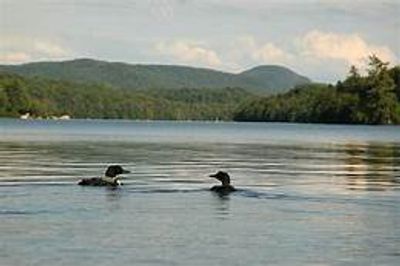
Loons are a major part of the enjoyment of Maine lakes and ponds from ice out to November. Their calls are eerily beautiful and the grace in which they glide and submerge are something none of us ever want to have to live without.
Maine Loon Project
This project has worked for more than three decades to assess the status and safeguard the future of Maine's loon population.
About the Annual Loon Count
From 7:00 AM to 7:30 AM on the third Saturday of July each year, over 1,000 volunteers venture onto lakes and ponds across the state to count loons. The observations recorded by our citizen scientist volunteers provide a "snapshot" of Maine's loon population throughout the state. In 2019, for the 36th year in a row, 1,414 volunteers participated in the count, up from 1,350 in 2018, covering 292 lakes.
2026 Results
Meddybemps Lake
Total Number of Adult Loons: X
Total Number of Chicks: 0
Lead Poisoning in Adult Loons
Don't forget to use lead-free fishing tackle as lead is one of the leading causes of death in loons.
Property Owner Education
Phosphorus Buildup
Phosphorus Buildup
Phosphorus Buildup
We, as property owners, can...
♦reduce the effects of polluted runoff, ♦protect the quality of our lakes and streams, ♦ and improve property values
by establishing new vegetated buffers or enhancing existing ones!
A beautiful green lawn is NOT a good thing for a lake!
It’s hard to believe one person’s expansive lawn or eroding camp road could be a threat to something as large and enduring as a lake. But when added to a shoreline full of similar sites, it can. All storm water that gets into a lake carries nutrients. Over time, the cumulative impact can be thousands of pounds of pollutants. The result, “death by a thousand cuts,” means algae blooms, fish kills, and the loss of water clarity and spawning habitat.
Buffer Zones
Phosphorus Buildup
Phosphorus Buildup
Leaving natural buffer growth in place or adding it makes a huge difference to the water quality over time. When it rains or snow melts, stormwater runoff picks up various pollutants such as dripped or spilled petroleum products, soil, fertilizer, pesticides, and animal waste and carries them to the nearest ditch, storm drain or stream and then on to lakes, rivers and bays. Individually small amounts of pollutants may seem insignificant, but collectively they add up to create the largest source of pollution to Maine’s waters. How can we keep these pollutants out of our waters? By reducing the source of pollutants and by capturing the stormwater before it moves off your property.
Septic Systems
Phosphorus Buildup
Septic Systems
One danger to the Lake that can be avoided is to be sure that your septic system is in good working order. Some camps were built almost a hundred years ago and those systems were not designed to support some of the more modern uses like washing machines, dishwashers, additions with extra baths, etc.
So, have your system checked out.
Lake Smart
Septic Systems
LakeSmart is an education and reward program that assists lakefront homeowners manage landscapes in ways that protect water quality. The program is free, non-regulatory and voluntary. Participating homeowners receive individualized suggestions for keeping pollutants in stormwater out of lake waters. This type of contamination is the leading cause of damage to lakes.
The Maine Lakes Society partners with lake associations to deliver LakeSmart education property-by-property and shore-by-shore to create a conservation ethic across lake communities. Trained volunteers perform property assessments for participating homeowners. Sites that score well earn the coveted LakeSmart Award, consisting of two distinctive blue and white signs that can be posted at the waterfront and driveway. The signs identify the homes of good stewards and illustrate what lake-friendly living looks like.
More information sources
Links that give detailed information for Shoreline Land Owners:
https://www.maine.gov/dep/land/watershed/camp/index.html
https://www.maine.gov/dep/land/slz/index.html
https://mainelakessociety.org/lakesmart-2/
Governance

MLA is governed by a Board of Directors and Bylaws incorporated in the State of Maine
The Board consists of:
Officers - President, Vice President, Secretary and Treasurer
There are 12 Directors
Our current Board:
President: Reese Robinson
Vice President: Elizabeth Townsend
Secretary: Katy Hews
Treasurer: Diane James
Directors:
Karen Putnam, Pete Trouant, Jeff Orchard, Kate Holloway, Glenn Ball, Elizabeth Doran, Larry Fisch, Amy Salamon, Nancy Rombach, Mauricio Sada, Cheryl Zwingman
Annual Meeting
This meeting is held every year on or about the first Sunday of August at the Meddybemps Community Center at 11 AM. Next meeting is August 2nd, 2026.
Board Meetings
The whole Board meets at least once per year but often multiple times per year in person and with the use of online applications.
Committees
Fundraising - Chaired by Meg Teele-Rothberg
Pancake Breakfast - Chaired by Diane James
Board Development - Karen Putnam
Water Testing - Cary James
Community Boat Inspection Program - Durell Buzzini